5 strategies to turn followers into clients with your Plinfy website
5 practical strategies to use your Plinfy website as a bridge between your followers and your next clients.

Last updated: August 14, 2026
Turning followers into clients requires a bridge between the interest generated on social media and the decision to hire. That bridge is the professional website. The average social media conversion rate is between 1.8% and 3% (Shopify, 2025). A well-structured website can double that number by offering clarity, social proof, and an easy way to get in touch. This article presents 5 practical strategies to use your website as a conversion engine.
Summary: Social media generates attention; websites convert attention into clients. The 5 strategies in this article cover a clear presentation, social proof, lead capture, data tracking, and mobile performance. Each one includes a practical example by profession.
Social media generates attention; websites convert attention into clients
Professionals who combine social media with a professional website have a more direct path from audience to client. And the data explains why: the average social media conversion rate is between 1.8% and 3%, according to Shopify (2025). For accounts with fewer than 10,000 followers, that number can be even lower (Chatdesk, 2024). The reason is structural: social networks were built to maximize time on the platform and engagement, not to make commercial conversions easier. Notifications, stories, and algorithms that prioritize entertainment constantly compete for your potential client's attention. That is where the professional website comes in: it works as the strategic bridge between interest and action. Next, 5 practical strategies to use that bridge intelligently.
1. Present clearly who you are and what you do
When someone lands on your website, you have 0.05 seconds (fifty milliseconds) to make a good impression. In that time, according to Sweor, visitors have already formed an initial opinion about your professionalism. A lack of clarity is one of the biggest reasons people leave. According to HubSpot research, 38% of users abandon websites with confusing layouts or unclear information. If someone has to think too hard to understand what you offer, the opportunity for contact can slip away. 75% of consumers judge a professional's credibility based on the website's design and clarity, according to Stanford Web Credibility Research. Before they even read your qualifications, they have already formed an opinion about your trustworthiness.
How to do it on Plinfy:
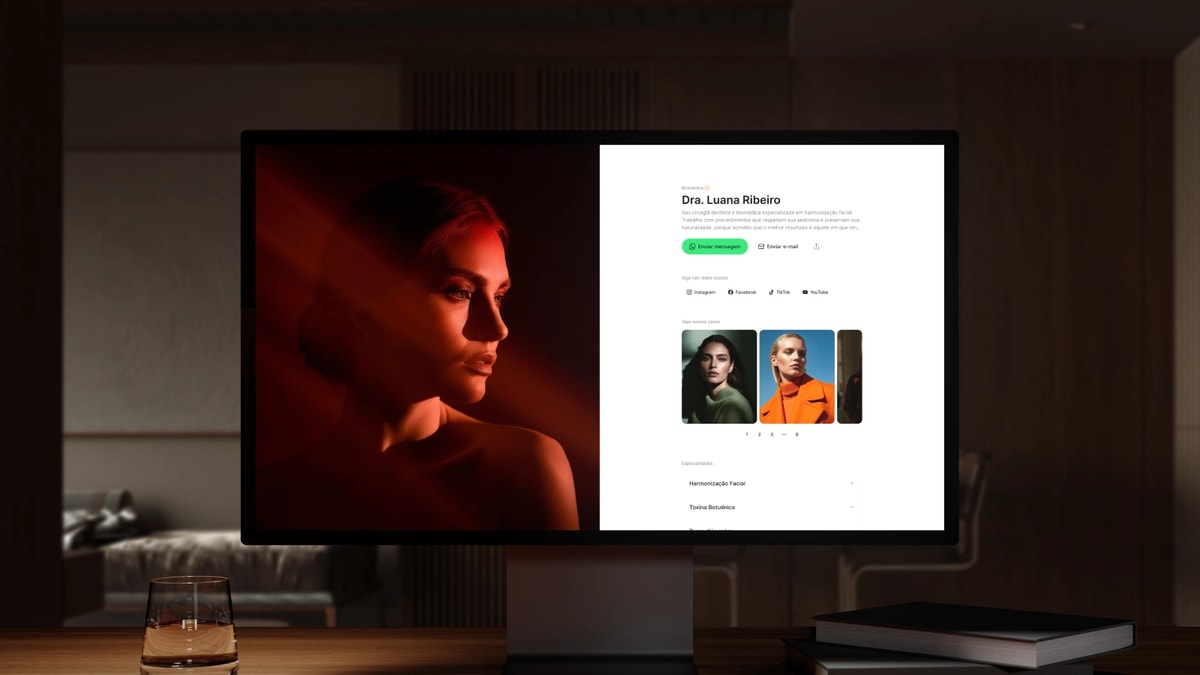
Use the "Profile" section in the editor and add:
- Professional photo: it can be your photo, your brand, or your visual identity. What matters is that it is high quality and aligned with the context of your website
- Direct headline: explains exactly what you do (e.g. "Sports Nutrition for Athletes")
- Explanatory bio: your value proposition in 2-5 clear lines.
- Primary action button: WhatsApp and email for immediate contact
Practical example:
❌ Unclear: "Hi! I'm Dr. Maria and I love what I do." ✅ Clear and direct: "Nutritionist specialized in sustainable weight loss. I help women over 30 lose weight without restrictive diets, with personalized support." Visitors don't want to guess whether you can help them. When they understand right away, the likelihood of contact goes up.
Tip: Need help putting together your professional presentation? Visit plinfy.com/academy and download resources to help you build your professional digital presence.
2. Build trust with strategic social proof
79% of consumers trust online reviews as much as personal recommendations, according to Popupsmart. Social proof is not optional; it is essential for conversion in digital environments. But there is a detail few people know: according to Reevoo research, 68% of consumers trust reviews more when they see both positive and negative ones. Generic, overly positive testimonials can come across as less authentic. Genuine, specific social proof converts more.
How to do it on Plinfy:
Use the "photos, videos, or text" sections to add social proof:
- Before and after: with real photos (especially effective for architects, nutritionists, dentists, physical therapists)
- Full testimonials: with the client's full name and photo
- Specific success stories: with measurable results and context
- Company logos: of businesses you serve or have served (if applicable)
- Behind-the-scenes of the process: showing professionalism and care
Practical example:
❌ Generic: "A satisfied client said they loved it!" ✅ Specific: "Maria Silva lost 15kg in 4 months following the personalized program. 'I finally found a nutritionist who understands my busy routine. The results came naturally, without suffering.' Maria, 42, business owner" Specificity creates credibility. Numbers create trust. Real faces create connection.
3. Offer something valuable in exchange for contact (Lead Magnet)
This technique works because most people prefer to receive something of value before deciding to hire or buy. According to HubSpot, offering relevant free content can increase conversion of visitors into qualified leads by up to 55%. You are not just gaining an email; you are starting a relationship of trust. Well-optimized professional websites convert visitors into leads at rates significantly higher than standalone social media profiles. According to Invesp, the average website conversion rate is 2.35%, with the best websites reaching 11%+. A well-placed lead magnet captures contact information in a non-invasive way and opens the path to being hired.
How to do it on Plinfy:
Create a link or a specific section with a free offer:
- Relevant e-book: about a specific problem your audience has
- Practical checklist: that delivers immediate, actionable value
- Free consultation or assessment: works very well for professional services
- Access to an exclusive group: on WhatsApp or Telegram
- Discount on the first purchase: for physical or digital products
Use clear calls to action such as:
- "Download my free guide on [specific problem]"
- "Get a no-obligation assessment"
- "Get exclusive content by signing up here"
Practical example:
- For nutritionists: "Free e-book: 7 Common Mistakes That Sabotage Weight Loss"
- For architects: "Free checklist: 10 Points to Evaluate Before a Renovation"
- For lawyers: "Download for free: Tax Handbook for Independent Contractors"
Start capturing qualified leads with your Plinfy website. Try the most complete version free for 7 days, no credit card required.
4. Track visitors with marketing tools
Understanding which networks, posts, or campaigns are bringing visitors to your website helps you make more strategic decisions and optimize your investment in content and ads. You are investing time creating content. Knowing which type actually generates contacts, which network converts more, and which pages keep visitors engaged turns that effort into data-driven decisions.
How to do it on Plinfy:
Go to the Analytics tab in your dashboard and add:
- Google Analytics or Tag Manager: shows how many people visit your website, where they come from (Instagram, Google, WhatsApp, DMs), how long they stay on each page, and which sections convert more.
- TikTok Pixel and Meta Pixel: lets you track conversions from paid ads, create custom audiences for remarketing, and understand the visitor's full journey through conversion.
Plinfy makes it easy to connect both tools with no code. Set them up once and get data continuously. 60.67% of website traffic comes from mobile devices, according to Datareportal. Knowing where your traffic comes from and how it behaves helps you identify which type of post generates more clicks on the link in bio, which section of the website can be improved, and when your visitors are most likely to get in touch.
5. Make sure your website is fast and mobile responsive
More than 60.67% of website visits happen on a phone. A fast, well-adapted experience keeps the visitor engaged long enough to make a decision. Websites that take more than 3 seconds to load lose 40% of visitors, according to Sweor. Each additional second can reduce conversions by up to 7%. Speed is not a technical detail; it is part of the client experience.
How Plinfy solves this:
Every website created with Plinfy is automatically:
- 100% responsive: they adapt perfectly to any screen size
- Optimized for speed: they load in under 3 seconds
- Mobile-first: designed first for the smartphone experience
- Tested on every device: they work perfectly on iPhone, Android, tablets, and computers
You don't need to worry about technical details. Plinfy makes sure everything works on any device. Websites that load in under 3 seconds keep 47% more visitors engaged, according to Sweor. That difference translates directly into more contacts and more clients.
Bonus: integrate everything into a cohesive strategy
The 5 strategies above work together as an integrated conversion system:
- A follower sees your post on Instagram/TikTok (engagement)
- Clicks the link in bio (strategy 5 ensures a fast load)
- Immediately understands what you offer (strategy 1)
- Sees social proof that builds trust (strategy 2)
- Downloads your lead magnet in exchange for their contact (strategy 3)
- You track the full journey and optimize continuously (strategy 4)
- Follow up the relationship via email/WhatsApp until they convert into a client
Plinfy is a global platform for independent professionals to create a professional website with no code, with a template generated automatically from the profession provided at signup. See examples by profession at plinfy.com/inspiracao. The platform offers a free plan to get started, plus paid plans starting at R$49/month with advanced features and exclusive, unlimited sections. The 7-day trial gives full access to the Max plan with no credit card required. To get the most out of every visitor who arrives from Instagram or TikTok, also see how to optimize your link in bio to convert more.
What these strategies mean in concrete numbers
Considering the average conversion rate of well-structured websites (2.35% to 3%, according to Invesp) applied to different professional profiles:
- Nutritionist with 5,000 followers (consultation R$300): the difference between 1.8% and 3% conversion represents 60 additional patients per year, R$18,000 in incremental revenue
- Dentist with 3,000 followers (average procedure R$1,500): 36 additional patients, R$54,000/year
- Lawyer with 2,000 followers (average case R$5,000): 24 additional cases, R$120,000/year
These are conservative projections based on the average rates cited above, without considering the value of recurring clients or referrals generated over time.
Frequently asked questions about converting followers into clients
Why aren't my followers turning into clients?
The main reason is the lack of a clear step between interest and contact. Social media converts between 1.8% and 3% of followers (Shopify, 2025). A website with a clear presentation, social proof, and a visible contact button can double that rate by reducing friction in the decision to hire.
What is the conversion rate of a professional website?
The overall average is 2.35%, with the top 10% of websites reaching 11%+ (Invesp, 2024). For service professionals with an optimized website, a clear presentation, and relevant social proof, rates between 3% and 5% are consistently achievable.
Is it worth having a website even with few followers?
Yes. A website appears on Google regardless of your follower count, which means you can be found by people who have never seen your Instagram. 68% of online experiences start with search (BrightEdge). Websites and social media capture different audiences.
How do I use my website alongside social media to convert more?
The most effective flow starts with content on social media, which drives a click on the link in bio, which takes the user to a website with a clear presentation, social proof, and a direct contact button. Each step has a role: social media generates attention, the website converts attention into contact, and contact becomes a client.
Conclusion: build bridges, not just an audience
Social media and a professional website do not compete; they complement each other. Social media generates attention and relationship; the website converts that attention into real contacts and clients. The 5 strategies in this article work as an integrated system: a clear presentation, social proof, lead capture, data tracking, and mobile performance. Each one reinforces the others. Consider implementing at least one this week and track the results over the next 30 days. Don't have a website yet? Get started on Plinfy now and enjoy 7 days free on the Max plan, Plinfy's most complete version, no credit card required.
Sources:
- Shopify, 2025: "How To Improve Your Social Media Conversion Rate (2025)"
- Chatdesk, 2024: "Social Media Conversion Rate Benchmarks (and How to Beat Them)"
- HubSpot, 2023: "State of Marketing Report (2023)"
- Datareportal, 2024: "Global Mobile Traffic Statistics (2024)"
- Popupsmart, 2025: "Impressive Social Proof Statistics You Should Know in 2025"
- Sweor, 2024: "27 Eye-Opening Website Statistics: First Impressions Matter"
- Invesp, 2024: "Conversion Rate Optimization Statistics"
- Reevoo, 2023: "The Power of Customer Reviews"
- Stanford Web Credibility Research, 2023: "How Do People Evaluate a Web Site's Credibility?"